The Argungu Fishing Festival: Performance, Heritage, and Aesthetic Expression in Northern Nigeria
by Glory Onyekwusi Feb 18, 2026
Introduction
The Argungu Fishing Festival, held in Argungu, Kebbi State, represents one of West Africa’s most significant cultural festivals. Beyond its popular image as a large-scale fishing competition, the festival functions as a complex cultural performance that integrates history, diplomacy, ritual, visual identity, and communal aesthetics. From an academic perspective, it offers fertile ground for discussions in African art history, performance studies, anthropology, and heritage preservation.
Historical Origins
The festival originated in 1934 as a symbolic reconciliation event following tensions between the Sokoto Caliphate and the Kebbi Kingdom. Initially conceived as a peace-building initiative, the festival gradually evolved into an annual cultural gathering that incorporates fishing competitions, traditional wrestling, music, dance, and equestrian displays.
Today, it is formally known as the Argungu International Fishing and Cultural Festival and is typically celebrated annually between February and March, although specific dates may vary depending on governmental and environmental considerations.

Performance and Communal Aesthetics
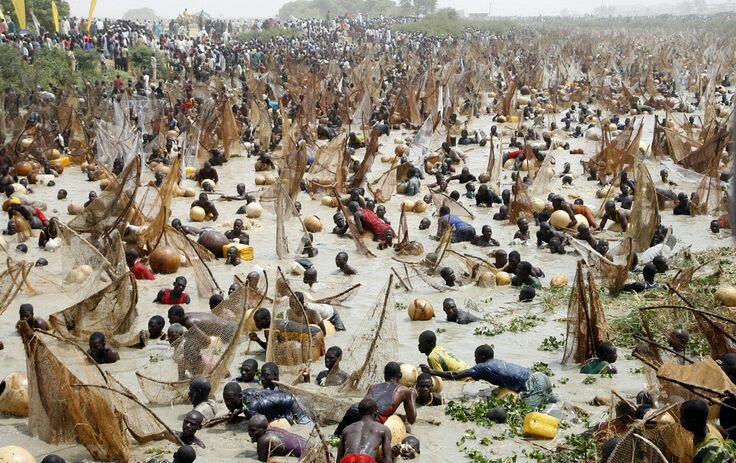
From an academic standpoint, the Argungu Fishing Festival can be understood as a form of collective performance art. Thousands of fishermen enter the Matan Fada River simultaneously, armed with traditional fishing tools such as hand nets and calabashes. The synchronized movement of bodies, textiles, and splashing water creates a dynamic visual composition that reflects indigenous aesthetics centered on rhythm, communal participation, and embodied tradition.
Unlike Western art frameworks that separate artwork from audience, Argungu collapses this distinction. Participants and observers co-create the spectacle, making the festival an example of art as lived social practice rather than isolated object production.
Textile, Identity, and Visual Culture
The festival also serves as a platform for the display of Hausa sartorial traditions. Embroidered robes, patterned caps, and symbolic color schemes reflect regional craftsmanship and identity markers. These textiles are not merely decorative; they communicate social status, lineage, and cultural belonging.
Such visual elements situate the festival within broader discussions of African visual culture, where clothing, movement, and ritual become integral to aesthetic expression.
Intangible Cultural Heritage and Decolonial Perspectives
Scholars increasingly frame festivals like Argungu as forms of intangible cultural heritage. This designation emphasizes practices, performances, and knowledge systems rather than static objects. In doing so, Argungu challenges colonial-era art historical classifications that often privileged material artifacts over performative traditions.
Within contemporary African art discourse, the festival exemplifies how cultural expression remains embedded in social systems, ecological relationships, and collective memory.
Symbolism of Water
Water occupies central symbolic significance in many African cosmologies, representing fertility, renewal, and continuity. The communal plunge into the river is therefore not solely competitive but symbolically regenerative. It reaffirms the community’s relationship with land, environment, and ancestral heritage.
Conclusion
The Argungu Fishing Festival should not be viewed solely as a tourism event or economic attraction. It is a multidimensional cultural phenomenon that embodies historical reconciliation, communal identity, visual aesthetics, and performative tradition. For scholars of African art and cultural studies, it illustrates how artistic expression in African contexts often transcends gallery spaces and instead manifests in ritual, movement, and collective experience.
As such, the festival remains an enduring testament to the vitality of indigenous cultural systems in contemporary Nigeria.
Image Source / Thumbnail source – Throwback image of 1966-1967: Argungu Fishing Festival. Photos taken by Gerald Sodomka. Image source: The Nigerian Nostalgia/Kebbi daily updates