Nora Chipaumire Brings Zimbabwean Cosmology to Tate Modern
by Glory Onyekwusi Jul 2, 2026
With “gadzi,” the Infinities Commission 2026 turns Tate Modern’s East Tank into a living organism shaped by Shona ancestry, sound and stone.
Tate Modern’s East Tank has been transformed into an imagined Zimbabwean landscape — one built from wood, wire, cardboard and sound rather than paint or canvas. The installation is gadzi, created by artist, choreographer and performer nora chipaumire (she styles her name in lowercase) as the recipient of the Infinities Commission 2026, Tate’s free annual platform for experimental, cross-disciplinary art.
What Is Gadzi?
The work takes its name from gadziguru, described in Shona cosmology as the oldest and most powerful female presence — a generative force tied to land, ancestry and creation. According to Tate, gadziguru is connected to sacred sites across Zimbabwe, including Domboramwari, Great Zimbabwe, Matopos and Domboshava, and is regarded as the mother figure behind the country’s famous Balancing Rocks.
Chipaumire resists calling gadzi an “installation,” preferring the word “organism.” Sculpture, sound, moving image and live performance share the same space, activated by visitors moving through it rather than observing from a distance. Built from granite-toned forms, red soil tones and towering hand-built structures, the work is designed to be felt physically — visitors can sit on speakers embedded within the sculptures and experience sound as vibration as much as noise.
Central to the work is chipaumire’s sound system — a monumental tower of speakers developed with artists Ari Marcopoulos and Kara Walker and built by Matt Jackson Studio. It carries the bass of dub music alongside saxophone, guitar and Zimbabwean mbira, linking the installation to a broader lineage of sound-system culture.

Chipaumire’s practice has, over the past decade, increasingly turned toward Shona cosmology and ancestral knowledge, deliberately looking past the colonial histories that shaped southern Africa’s art and identity. Born in 1965 in Rhodesia — now Zimbabwe — she has described her work as sitting at the intersection of multiple imaginaries: African, Black, woman. Her practice spans opera, dance, installation and film, carrying what’s often described as a punk-inflected resistance through each medium.

Live Performance in the Turbine Hall
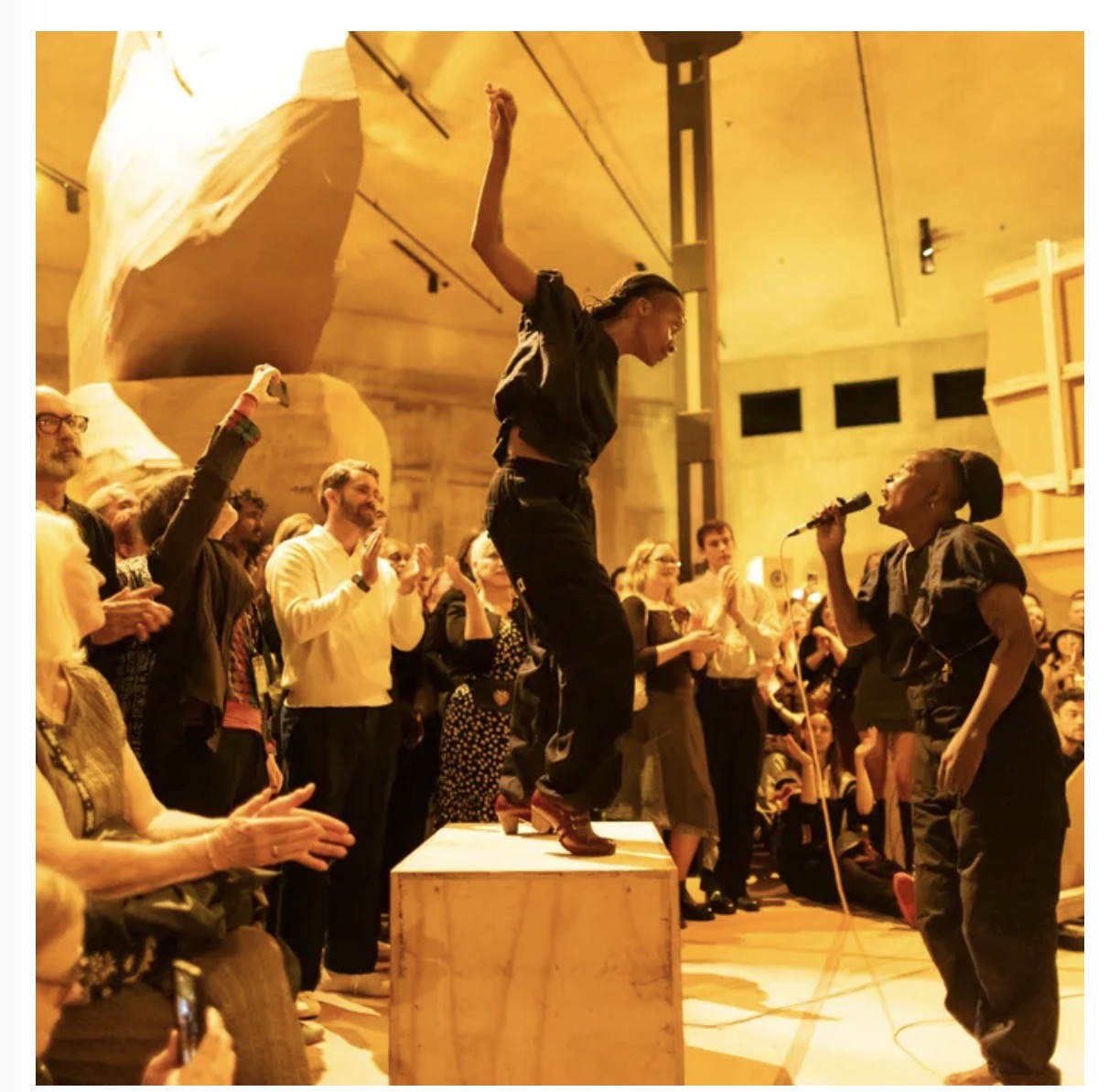
Gadzi extends beyond the East Tank. On Friday 26 June, Tate Modern hosted a special edition of its monthly Lates inspired by the commission, featuring music, conversation, film and workshops developed with chipaumire. Ten performers, dancers and musicians joined her for a live activation that moved from the East Tank through the Tanks Lobby and into the Turbine Hall, where her towering speaker sculpture stood as centerpiece.
The performance responded to what Tate describes as the precarious stability of Zimbabwe’s Balancing Rocks, using movement to explore questions of balance and equilibrium. Further live performances followed on 27 and 28 June, with free tickets required. Access to the whole performance is free, and visitors are invited to join in.
About the Artist
Nora chipaumire is an internationally recognized, multi-award-winning artist known for merging dance, opera, installation and film into a single restless practice. Before turning to movement, she studied law — an experience she has credited with shaping her interest in the body as a site of truth, as distinct from the constructed narratives of legal systems.

Exhibition Details
• Work: gadzi, Infinities Commission 2026
• Artist: nora chipaumire
• Curators: Valentine Umansky (Curator of International Art) and Francis Hardy (Assistant Curator of International Art)
• Venue: Tate Modern, East Tank and Turbine Hall
• On view: Now through 26 August 2026, free admission
• Supported by: Glass Castle Foundation