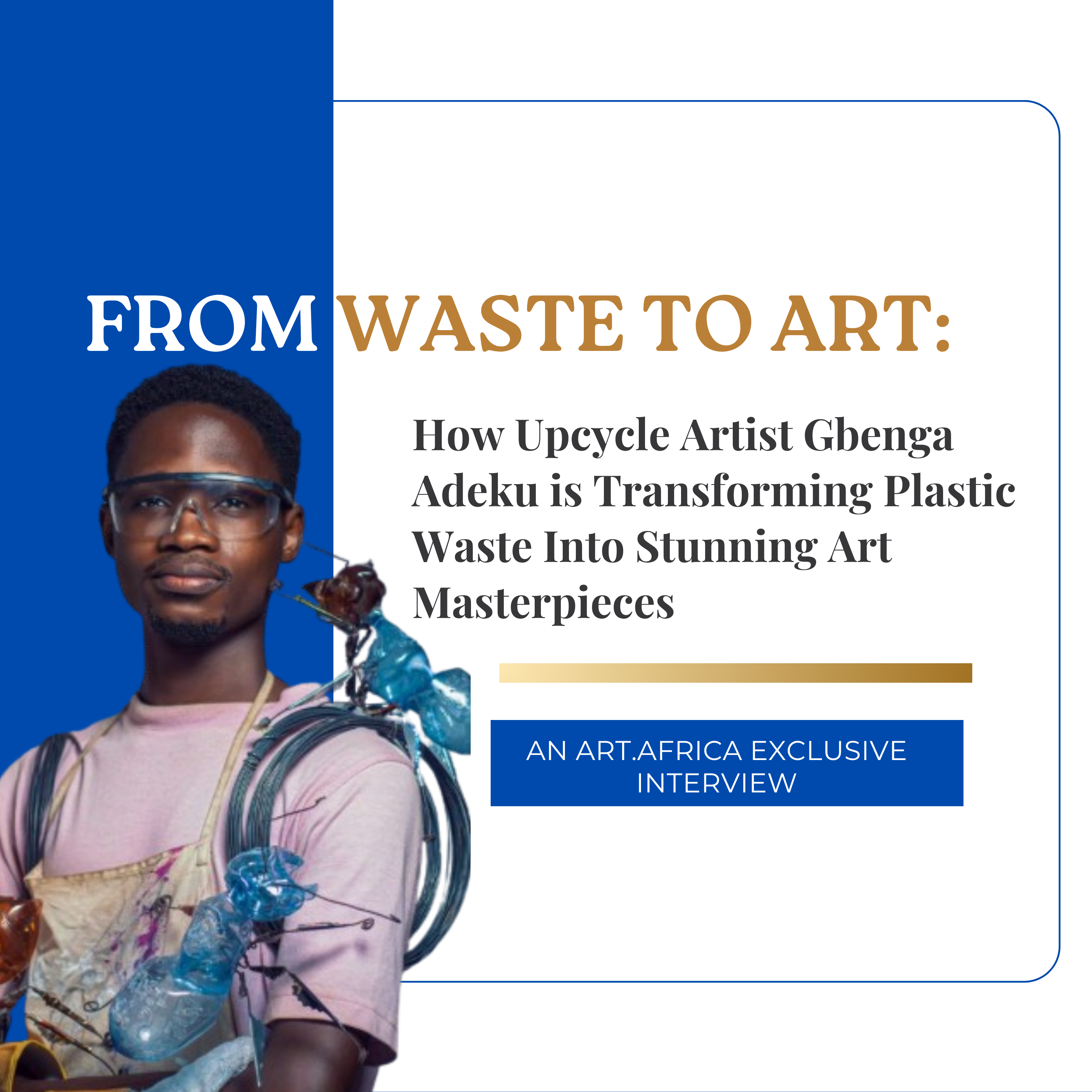
From Waste to Art: How Upcycle Artist Gbenga Adeku is Transforming Plastic Waste Into Stunning Art Masterpieces
by Queenswill Bestman Jul 31, 2025
In a world drowning in plastic waste, upcycle artist Gbenga Adeku has found beauty in what others discard. In this Art.frica exclusive, we interview Gbenga Adeku, a contemporary artist who represents a new generation of African creators addressing global environmental challenges through their craft.
Adeku’s artistic journey began in the most natural way possible. He was literally born into it. Growing up in his father’s studio, surrounded by neo-traditional art practices, he was given something many young artists never receive: complete creative freedom. “My dad didn’t want me to do one thing,” Adeku reflects. “I had the liberty to play around with materials and mess with whatever I wanted for myself.”

This foundation of artistic exploration would prove crucial as Gbenga developed his unique voice in contemporary sculpture. Unlike many artist children who feel pressured to follow their parents’ exact footsteps, Gbenga was encouraged to forge his own path, leading him to experiment with unconventional materials that his neo-traditional artist father had never touched.
Before settling on plastic as his primary medium, Gbenga Adeku experimented extensively with various materials including glass, hard paper, and metal. But plastic captured his imagination for both practical and philosophical reasons. “The process around plastic isn’t as tedious as bending glass,” he explains, noting the technical advantages. “But more importantly, I’m fascinated by it. I have it in abundance compared to all other kinds of waste.”
The abundance Gbenga refers to isn’t just personal convenience; it’s a global crisis that sparked his environmental awakening. A pivotal moment came when he read an article containing a stark prediction from environmentalist Abib Abba: “By 2050, there’ll be more plastic in the ocean than fish.”
This statistic transformed his perspective entirely. “I was generating all this waste, just me alone. Imagine millions of people across the globe who don’t even know the impact and dangers around this,” he realized. “I obviously can no longer be a part of that.”
Gbenga Adeku’s work with plastic goes beyond simple recycling. He manipulates the material, reshaping pre-formed plastic into new configurations to achieve his desired aesthetic results. The lightweight nature of plastic presents unique challenges, requiring him to incorporate metal as structural support creating hybrid sculptures that marry sustainability with engineering.
“Plastic itself cannot stand alone because it’s very lightweight,” he explains. “I need metal to be the bones.” This technical constraint has become a creative strength, with metal wires woven throughout his pieces, sometimes forming delicate ant legs or organic seaweed-like structures.

Perhaps most surprisingly, Gbenga’s greatest artistic mentor isn’t his father, Segun Adeku, despite their shared profession and daily proximity. Instead, he cites Nigerian metal artist Dotun Popoola as his primary influence. “My dad is not my art mentor,” he clarifies with affection. “He is my art friend.”
Gbenga also draws inspiration from Japanese sculptor Sayaka Ganz, who similarly creates with plastic waste. This international connection through shared sustainable practices demonstrates how environmental art transcends cultural boundaries, creating a global community of artists addressing similar challenges through their work.
This relationship dynamic with his father has proven invaluable. His father consistently pushes him toward innovation rather than imitation. “Every single time I come with something, he’s like ‘do something different,'” Gbenga shares. “He’s the kind of person who wants me to do my own thing.” This reverse mentorship has allowed Gbenga to develop a completely distinct artistic voice while maintaining connection to his artistic heritage.
For emerging artists seeking their own unique voice, Gbenga offers both encouragement and reality check. His primary advice is deceptively simple: “Start doing, no matter how scary it is.” But he’s honest about why he uses the word “scary.”
“If you’re trying to be like the world’s best footballer, your training is going to be more than a regular footballer,” he explains. “It’s going to be more painstaking, take more resources, and I don’t think you’ll live like a normal human being because of how much you put into whatever it is.”
The path of artistic innovation, particularly in addressing global challenges through art, requires extraordinary commitment. But Gbenga believes the rewards justify the difficulty. “If you keep going on that route, because it’s the scary part, not a lot of people are on it. So you’re sort of one of one, and it would be an amazing adventure.”
Gbenga Adeku’s work represents more than aesthetic innovation. It embodies a form of environmental activism that speaks through beauty rather than protest. By transforming waste into wonder, he creates tangible proof that sustainability and artistic excellence can coexist.
His sculptures serve as both art objects and conversation starters about consumption, waste, and our relationship with materials. Each piece represents plastic diverted from potential ocean contamination, transformed into something that celebrates rather than degrades our environment.
As he continues developing his practice, he remains committed to the experimental spirit that defined his early years. “I’m learning as I work,” he says of his plastic manipulation techniques. “The discoveries of a new medium, it’s very fulfilling.”
This commitment to continuous learning, combined with his environmental consciousness and technical innovation, positions Gbenga Adeku as a significant voice in contemporary African art. His work proves that the next generation of artists isn’t just creating beauty, they’re actively working to solve the problems they’ve inherited.
In a world facing unprecedented environmental challenges, artists like Gbenga Adeku offer hope through action. By transforming waste into art, they’re not just changing materials, they’re changing minds, one sculpture at a time.
Watch the full Art.frica exclusive interview with Gbenga Adeku to learn more about his artistic process, sustainability philosophy, and advice for emerging artists.