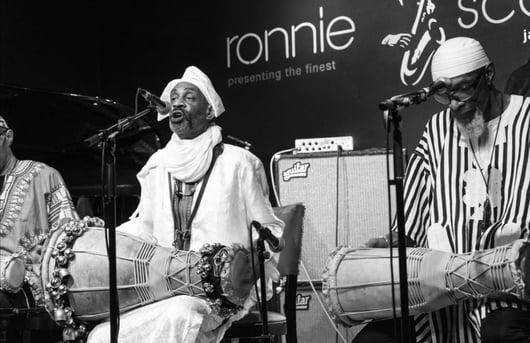
Batá Drums, Divination, and Jazz: The Kevin Haynes Story
by Queenswill Bestman and Onyekwusi Oluchi Glory Feb 6, 2025
In an exclusive interview with Art.Africa, Kevin Kaynes, a renowned musician and an Ifa Priest shares how his passion for the Batá drum fuels his innovative fusion of jazz, Afro-Cuban, and traditional African sounds. Although born in London, Kevin’s roots, artistry and spiritual journey are deeply connected to West Africa.
Kevin was born into a family rooted in Yoruba traditions, and his life has been anything but ordinary. His mother, a Yoruba woman from Benin Republic, and his father, who hails from Ile-Ife and Abeokuta in Nigeria, ensured Kevin grew up with a strong sense of his heritage.
Kevin is also a musical artist. His connection to music is deeply personal. Coming from a family of drummers, Kevin’s musical journey was influenced by his grandfather, a saxophonist. Though he often watched his grandfather play, he never dared to touch the instrument himself. Eventually, he was able to afford his own saxophone and began learning. In London, he met a musical band of instrumentalists who played saxophone and attended their free classes twice a week, refining his skills. He officially started his musical career in 1990, but by 1999, he had firmly established himself, releasing his first album Tomorrow’s Path, and making a name for himself in the global music scene. What makes Kevin’s music unique is that he not only plays the Batá drums but is also a priest, which brings a rare depth to his sound. While many can learn to play the drums, Kevin explains that it’s a different experience for those from a lineage of drummers. His music, infused with his spiritual practice and family heritage, is truly one of a kind.

Kevin’s music blends Yoruba traditions with modern sounds, reflecting his roots and experiences. He combines Yoruba and West African drumming with jazz and Afro-Cuban influences, creating a unique and soulful sound. His work often took him around the world, including performances at international Jazz festivals in Berlin, Cuba, Holland and France that occur annually. It was during one of his trips to Cuba in 2011, after an electrifying performance with legendary Chucho Valdez, Kevin earned the nickname “The African Charlie Parker.” The name was given to him in recognition of the rich vintage and soulful tone he produces when he plays the Saxophone. As the bandleader and founder of Kevin Haynes Grupo Elegua, he has led performances at renowned venues such as The Ronnie Scott’s Jazz Club, London’s Royal Albert Hall’s Elgar Room and other numerous prestigiuous establishments. His musical footprint extends beyond Europe, with notable performances in West Africa, including a collaboration with Jabel Cissokho in Dakar, Senegal. Kevin’s evolution—from a young musician in London to a revered Ifa priest in Nigeria—has not only transformed his sound but also caught the attention of platforms like Art.Africa, which celebrate African culture and heritage.

KEVIN’S SPIRITUAL JOURNEY TO IFA
His mother’s roots from Benin Republic, and his father’s lineage from Ile-Ife and Abeokuta, have guided him toward spiritual growth and cultural preservation. But it was during a visit to his father’s hometown in Abeokuta that Kevin’s life took a transformative turn, setting him on the path to becoming a Babalawo (an Ifa priest).
Kevin’s spiritual awakening began where he immersed himself in Ifa, a traditional Yoruba spiritual system. For over three decades, he lived in an “ile” (a house of learning), studying under seasoned Ifa priests to understand the sacred rituals, divination techniques, and wisdom of Ifa. This training has shaped him into a Babalawo, a priest and diviner who guides others seeking spiritual clarity.
Listening to Kevin Haynes, you quickly realize he is more than a musician or spiritual guide. He is a living embodiment of the Batá drum’s power, a connection to his heritage, his community, and the spiritual essence that shapes his journey. “Ayangunlu,” he says quietly, referring to his spiritual name. “It speaks of the drummers, the ones chosen to carry messages through rhythm and light. My purpose is to honor that calling for my people and for the generations yet to come, he told Art.Africa.
THE BATA DRUM- A FAMILY TRADITION
Kevin’s journey back to his roots truly began with the Batá drum. “In my family, the Batá drum has been played for over 800 years,” he shares,
It isn’t just an instrument; it’s a voice. It calls out to the ancestors, it speaks the language of the spirits. And now, it’s my turn to carry that legacy forward.
The Batá drum’s history is as rich as its sound. Traditionally, it is a Yoruba drum that dates back centuries, originating from the ancient city of Ile-Ife, which is considered the spiritual and cultural heart of the Yoruba people. The drum was originally used in sacred ceremonies and rituals, where it served as a vehicle for invoking the gods, ancestors, and divine forces. It was said that the sound of the Batá drum was so powerful that it could stir the spirits of the departed, summon rain, or even offer protection.

The drum’s unique shape, with its hourglass figure and two heads, is designed to create specific tones and rhythms that correspond to different spiritual frequencies. “When you tap the drum, it speaks,” Kevin shares.
“When I beat the drum, it’s not just about the music,” he explains,“Tapping my hands on the ground while playing is my way of calling to the ancestors. The drum speaks for me. It sends out frequencies that can bring harmony if played right.”
REDEFINING THE SPIRITUAL LEGACY OF IFA
Ifa teaches us that everything in life is connected,” Kevin explains. “The drum, the earth, the sky, and the spirits are all in constant communication. I use the Batá drum and divination to help people understand their path in this world.”
When asked how he addresses the stereotypes surrounding Ifa traditional worship, Kevin responded “I ask people to reflect on their roots, what was practiced before colonization, before outside influences? Ifa is not what many think it is—it’s a science, a sacred system of knowledge designed to harmonize humanity with the natural world,” he explains. “It’s about balance, energy, and living in tune with the universe.” Kevin actively works to dispel misconceptions about Ifa, which is often misunderstood due to widespread misinformation. He emphasizes its role as a tool for spiritual growth and cultural connection, one that can bring clarity and purpose to those who embrace it.
Kevin is also a prominent figure in the annual Vodun Festival held every January 10th in Ouidah, Benin. The festival is a celebration of ancestral spirits and cultural traditions and attracts thousands of participants from across the world, especially members of the African diaspora eager to reconnect with their heritage.
The Vodun Festival honors the spirits of ancestors and the sacred connection between humanity and the spiritual world. Central to the event are the Egungun (ancestral masquerades) that represent the spirits of the departed. For Kevin Haynes, the festival is not just an opportunity to participate but a responsibility to preserve, elevate these sacred traditions and celebrate the spirit of our ancestors.
“Egungun are more than just colorful costumes,” Kevin explains. “They are the living presence of our ancestors, reminding us of who we are and the paths they paved for us.”
CULTURAL PRESERVATION AND COMMUNITY IMPACT: KEVIN’S SCHOOL IN BENIN
Kevin moved to Benin in 2021, driven by a vision of cultural preservation and sustainable living. Beyond music and spirituality, he has made significant strides in community development. During one of his visits to Osogbo as an adult, he noticed large areas of unused land while simultaneously exploring videos on sustainable living. He was drawn to the idea of self-sufficiency and economic viability, realizing that in Nigeria and Benin, one could acquire land, build from the soil, and create a life from the ground up—something not easily possible in Europe. In 2014, he enrolled in a Permaculture and Design institute where he studied Permaculture and Design. This realization influenced his decision to relocate and settle in Benin Republic. His goal was to show the people of Benin the joy and benefits of sustainable living.
In Benin, he has established a school that serves as a hub for cultural preservation and sustainable living. The school teaches Batá drumming, Ifa spirituality, and sustainable agriculture, offering a space for people to reconnect with their roots while learning practical skills. “This is a project I am passionate about,” Kevin admits. “It’s about preserving our traditions and ensuring they thrive in future generations.” When asked about challenges in bringing the school project to life, he explains that while working on raising capital, his faith has guided him through it. “I’ve invested a lot of my savings into this project, relying on my spiritual practices and consultations with Ifa to guide me through difficult times. I speak to Ifa, I consult the spirits, and somehow, the money always finds its way to me.”
Kevin’s school has become a shining example for the African diaspora, inviting people to explore their heritage and embrace sustainable living practices. Recognized by Art.Africa as a beacon of cultural innovation, Kevin’s initiatives underscores his belief that reconnecting with one’s origins can bring a sense of purpose. Engaging closely with Africans in the diaspora. He acknowledges their strong cultural ties to the Ifa traditions. “The Ifa culture in Cuba is the strongest outside West Africa,” he notes. “Other countries like Brazil and the Caribbean practice fragments of Ifa, but I hope more people will come to know themselves and their origins. When you know who you are, you don’t have to relocate to another country to find purpose.”