Tracing the Origins of Ifá Divination and Its Surprising Parallels with Modern Binary Code
by Glory Oluchi Onyekwusi Sep 22, 2025
When most people hear “binary,” they picture streams of ones and zeros powering laptops, smartphones, or the internet itself. But here’s a twist: long before computer science, centuries before German mathematician Gottfried Wilhelm Leibniz published his work on binary in 1703, the Yoruba people of West Africa had already developed a sophisticated system that looks strikingly similar.
This ancient system is called Ifá divination, and at its heart is a brilliant mathematical structure hidden in plain sight. While Ifá was never meant to run machines, it did something arguably more impressive: it powered culture, preserved wisdom, and offered spiritual guidance that has survived thousands of years.
The Origins of Ifá
In Yoruba tradition, the supreme deity Olódùmarè entrusted divine wisdom to Ọ̀rúnmìlà, the god of knowledge and divination. From him came the Ifá corpus, a body of verses, stories, and proverbs encoded into patterns that priests, known as babaláwo, use to guide people through life’s mysteries.
The Yoruba pantheon includes other deities such as Ṣàngó (god of thunder and justice), Ògún (god of iron and war), and Yemoja (mother of waters). Each deity had its own channel of communication with humanity, but Ifá became the central system for seeking answers to problems both ordinary and profound.
Traditional accounts suggest Ifá divination has been practiced for thousands of years. Some scholars link its mathematical form to structures that could date back over 2,000 years, though Yoruba oral traditions often place its roots much deeper in time.
How the System Works
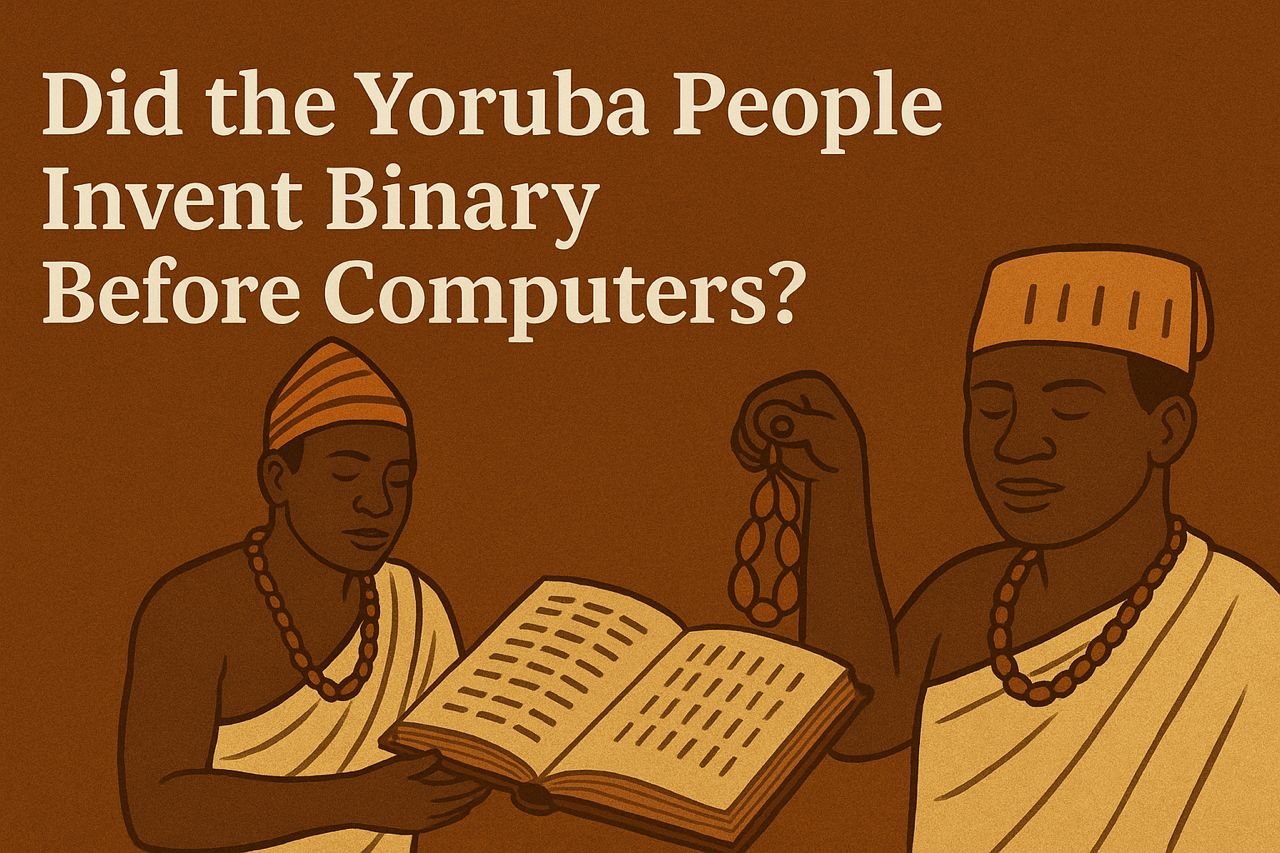
Ifá divination typically involves either a chain of sacred seeds (ọ̀pẹ̀lẹ̀) or palm nuts. When a babaláwo casts them, they fall into patterns of marks. These marks are recorded in two columns of four lines each.
Here’s the beauty of it:
- A single mark (|) can be read as “open” or “odd.”
A double mark (||) can be read as “closed” or “even.”That’s it—two possible states. Just like binary’s 1 and 0.
- From one column of four marks, there are 16 possible outcomes (2⁴ = 16). Place two columns side by side, and you now have 256 possible patterns (2⁸ = 256). Each of these patterns is called an Odù, and each Odù corresponds to a vast collection of verses, stories, and teachings.
So when a divination is made, the babaláwo isn’t just reading marks. They’re “retrieving” knowledge from a massive oral database, recalling the exact story or proverb tied to that Odù, and applying it to the seeker’s question.
Binary Before Binary?
In modern computing, a byte, the fundamental unit of digital storage, is made up of 8 bits, giving you 256 possible combinations. Sound familiar?
The parallel is hard to miss:
- Ifá Odù – 256 possible signs.
- Computer byte → 256 possible values.
This resemblance has caught the attention of mathematicians and anthropologists alike. Ron Eglash, in his book African Fractals (1999), describes Ifá as one of the most advanced indigenous mathematical systems, showing clear examples of combinatorial reasoning centuries before Europe formalized it.
Even more fascinating, Ifá shares a structural resemblance with the Chinese I Ching, another binary-based divination system that Leibniz himself studied before publishing his binary theory in 1703. The I Ching produces 64 hexagrams, whereas Ifá produces 256 Odù—four times as many possibilities.
Beyond Mathematics: Why It Matters
It’s tempting to frame Ifá as a kind of “proto-computer,” but that would miss the point. The Yoruba weren’t writing code or debugging apps. What they built was something more human: a knowledge system that encoded philosophy, ethics, and cultural memory into a repeatable structure.
Here’s why it matters:
- Mathematical Brilliance – Whether or not the Yoruba saw it as “math,” the Odù system demonstrates a deep understanding of how simple dual rules can generate vast complexity.
- Global Parallels – The Ifá system belongs in the same conversation as the I Ching and European binary, reminding us that mathematical thought has multiple cultural origins.
- Cultural Innovation – For too long, African contributions to science and math have been overlooked. Ifá is a reminder that innovation has never been the monopoly of the West.
Conclusion
So, did the Yoruba invent binary before computers? Not in the way Silicon Valley understands it. But they absolutely developed a binary-based system of thought—one that predates Leibniz and mirrors the principles of digital logic.
The next time someone mentions binary code, think beyond the screen. Think of a babaláwo under a tree, casting palm nuts, reading lines, and unlocking wisdom from a pattern of opens and closes.
Binary wasn’t born in Europe alone. In many ways, it was already alive in Africa.
References
- Eglash, Ron. African Fractals: Modern Computing and Indigenous Design. Rutgers University Press, 1999.
Abimbola, Wande. Ifá: An Exposition of Ifá Literary Corpus. Oxford University Press, 1976. - Olupona, Jacob. City of 201 Gods: Ilé-Ifè in Time, Space, and the Imagination. University of California Press, 2011.
International Journal of Innovative Technology and Research, Vol. 1, Issue 1 (2013)